Panel Materials Explained
The biggest trap for a home studio creator is the allure of cheap, egg-crate polyurethane foam. It looks like a recording studio, it's easy to glue to a wall, and it's inexpensive. However, from a standpoint of vector acoustic science, thin foam is practically useless for true broadband acoustic treatment.
To control the chaotic kinetic energy of soundwaves, we need mass, density, and depth. In this guide, we break down the three primary materials used in acoustic panels and bass traps, explaining the physics of why they work.
The Noise Reduction Coefficient (NRC)
Before comparing materials, you must understand the metric of absorption. The NRC is a scalar value ranging from 0.0 (perfectly reflective, like concrete) to 1.0 (perfectly absorptive). A material with an NRC of 0.8 absorbs 80% of the sound energy that strikes it. However, NRC is an average of mid-range frequencies. To truly evaluate a panel, you must look at its absorption coefficients across the frequency spectrum, especially at 125Hz and 250Hz.
Polyurethane Foam
Standard acoustic foam is highly porous and lightweight. It excels at absorbing frequencies above 4kHz (flutter echo, cymbals, harsh 'S' sounds in vocals).
The Flaw: Because it lacks mass, waves below 500Hz pass straight through it, hit the wall, and reflect back. Relying solely on foam results in a "dead" sounding room that is still overwhelmingly muddy in the bass and lower-mids.
Rigid Fiberglass (Owens Corning 703)
The industry standard for DIY and commercial broadband panels. It consists of densely packed glass fibers. A 2-inch thick panel of OC 703 has exceptional absorption down to 250Hz.
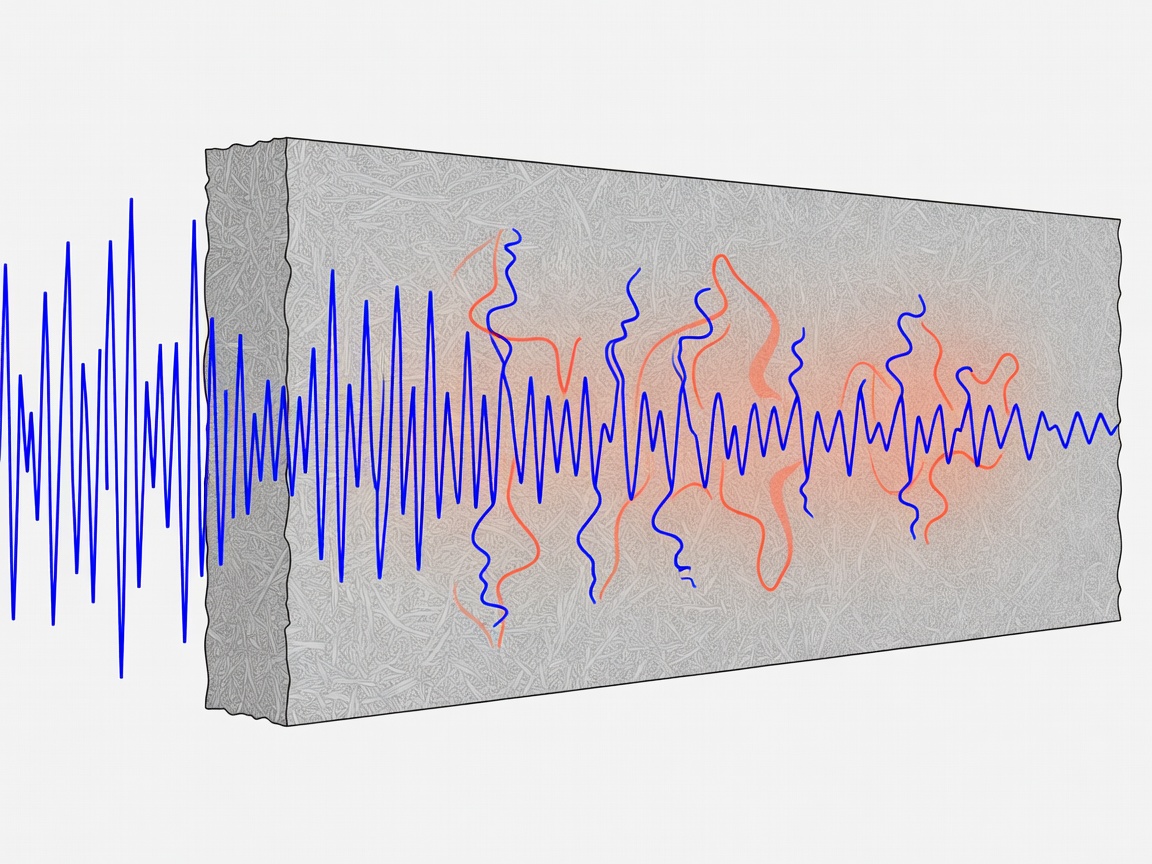
The Science: As sound waves enter the dense fibrous matrix, the friction causes the fibers to vibrate microscopically. This mechanical kinetic energy is converted into thermal energy (heat). The wave is destroyed.
Mineral Wool (Rockwool / Safe'n'Sound)
Created by spinning molten rock and slag into fibers, mineral wool is heavier and denser than fiberglass. It is exceptionally good at low-frequency absorption and is the material of choice for constructing thick bass traps to be placed in room corners.
While slightly more difficult to work with than rigid fiberglass due to its tendency to crumble at the edges, building 4-inch to 6-inch thick Rockwool panels across the corners of your room will drastically tighten your kick drums and bass synth monitoring.
The Air Gap Trick
Here is a piece of acoustic science that will save you money: sound waves have the highest velocity at a distance of 1/4 wavelength from the boundary (the wall). When sound hits a wall, its velocity is zero, but its pressure is highest. Porous absorbers rely on wave velocity to create friction.
If you mount a 2-inch fiberglass panel flush against the wall, it only catches the wave where it's slowing down. If you mount that same 2-inch panel with a 2-inch air gap behind it, it intercepts the wave further out where velocity is higher. You effectively double the low-frequency performance of the panel for free, simply by hanging it slightly off the wall.
| Material (2" Thick) | 125Hz | 250Hz | 500Hz | 1kHz | NRC |
|---|---|---|---|---|---|
| Standard Foam | 0.11 | 0.30 | 0.70 | 0.91 | 0.65 |
| Owens Corning 703 | 0.17 | 0.86 | 1.14 | 1.07 | 1.00 |
| Rockwool Safe'n'Sound | 0.25 | 0.95 | 1.15 | 1.05 | 1.05 |
* Values > 1.0 occur due to diffraction effects at the edges of the panels during testing.